Why a Basketball Court Has a Three-Point Arc
Why a basketball court has a three-point arc: learn how the boundary sets shot value, read corner markings correctly, and judge close calls by the shooter's feet.
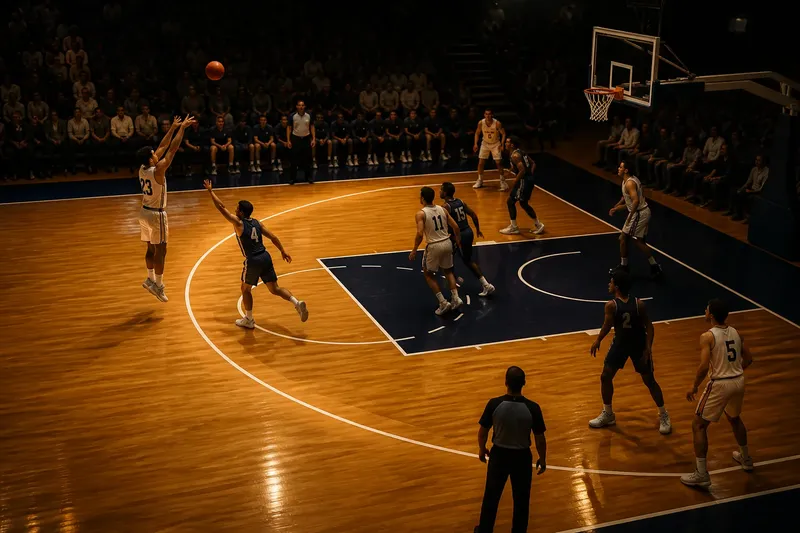
Why does a shot from just beyond the three-point arc count more than one from just inside it? The three-point arc marks a scoring boundary, but its curved section only approximates a consistent distance from the basket; the straight corner sections sit closer to the hoop. To judge a close call, start with the player’s feet at release and the markings nearest the shot.
The arc separates two scoring areas
The arc does not tell players where they must shoot. A successful field goal released from beyond the boundary is worth three points, while a field goal released from inside it is worth two. Free throws follow separate rules.
The line itself counts as part of the area inside the boundary. If a shooter’s foot touches it when the ball leaves the hand, a made shot counts as two points. A player can jump from beyond the arc and land inside after releasing the ball; the landing spot does not change the shot’s value.
Say a player catches the ball with one shoe touching the arc and shoots immediately. If the shot goes in, it counts as two points because the shoe was on the boundary at release. A teammate who releases from fully beyond the line can score three.
When watching, focus on the shooter’s feet at the instant the ball leaves the hand.
The curved arc and straight corners mark different distances
Across the top and sides of the court, the arc approximates a consistent distance from the basket. Near the baseline, it gives way to straight corner sections. Those segments are closer to the basket than the curved section at the top, so a corner three is not the same distance as a shot from beyond the top of the arc.
The court’s sidelines limit how far the curve can extend in the corners. The straight segment connects the markings there and still marks the three-point boundary. Exact court dimensions and rules can differ by league and level, so read the markings in the context of the competition.
Imagine a viewer comparing a corner attempt with one from the top of the arc. Both count as three if released beyond their respective boundary, even though the corner shooter is closer to the rim. The shorter distance can affect the shot’s difficulty, but it does not change the point value.
At the corner, follow the straight boundary as carefully as the curved arc.
Point value does not tell you how likely a shot is to go in
A three-point attempt is worth more than a two-point attempt, but that does not automatically make it the better choice. Distance, angle, balance, and defensive pressure can all affect the quality of a look. The arc defines the reward, not the likelihood of making a particular shot.
Imagine a player choosing between a guarded attempt from well beyond the arc and an open shot from inside it. The outside shot offers an extra point if made, while the open inside shot may be more comfortable. The better choice depends on the situation and the player’s ability, not on the line alone.
Crossing the boundary changes a field goal’s point value; moving farther from the hoop can also make a shot more demanding. Two attempts from beyond the arc both count for three, but they may differ in difficulty.
Separate “How many points?” from “How good a shot was that?”
Foot placement and viewing angle can make calls hard to read
From a distant seat or a television angle, a shoe can hide the line. A player may also be moving quickly, making it hard to tell whether contact happened before the release. Officials judge the play on the court, and video-review procedures vary by competition.
Use these checks to follow a close call:
- Locate the release: If the foot is beyond the line when the ball leaves the hand, count a made field goal as three; if a foot touches the line or is inside, count it as two.
- Look for line contact: If a shoe overlaps or touches the arc at release, treat the shot as inside; if both feet are clearly beyond it, treat a made shot as three.
- Check whether the player is planted: If a foot is down near the boundary at release, use that position to judge the shot; if the player has jumped, follow where the player took off from.
- Separate takeoff from landing: If the player releases from beyond the arc and then lands inside, keep the three-point classification; if the player was inside at release, count a make as two.
- Follow the corner segment: If the shooter is beyond the straight corner boundary, count a made shot as three; if the foot touches or falls inside that segment, count it as two.
- Check the official signal and score display: If they show a two-point ruling, follow that call unless the competition’s review process changes it; if they show three, treat the basket as a three-pointer.
When a view hides the feet or the release, the official signal and score display are more useful than guessing from the ball’s flight.
Why does the arc curve instead of forming a full circle?
Does every court use the same three-point distance?
No. The applicable distance and court layout can differ across leagues and levels. The arc still separates two-point and three-point field-goal attempts.
Does touching the arc count as a three-pointer?
No. A shooter touching the line at release is treated as inside the boundary, so a made field goal counts for two points. Releasing from beyond it and landing inside afterward does not by itself change the value.
Why is the corner section straight?
The sidelines restrict the space available for a full curve near the baseline. The straight segment completes the three-point boundary there, at a distance closer to the basket than the curved section at the top.
Is a shot from farther beyond the arc worth more?
No. A made field goal from beyond the line remains worth three points, however far away it is. Extra distance may make the attempt harder, but it does not increase the scoring value.
Read the arc as a scoring boundary
The three-point arc distinguishes two-point and three-point field goals. Its curved section approximates a consistent distance from the basket, while the straight corner sections adapt the boundary to the court’s edges and sit closer to the hoop. Watch the shooter’s position at release, not just the ball’s path.
When a shot looks borderline, locate the nearest boundary, check the feet, and note the instant of release. That sequence makes the three-point arc easier to read without mistaking a corner shot’s shorter distance for a different scoring value.